
Livestock Biosecurity Disease Prevention: Gaps That Cause Repeat Outbreaks




Livestock Biosecurity Disease Prevention: Gaps That Cause Repeat Outbreaks
Why does livestock biosecurity disease prevention fail even when protocols exist?
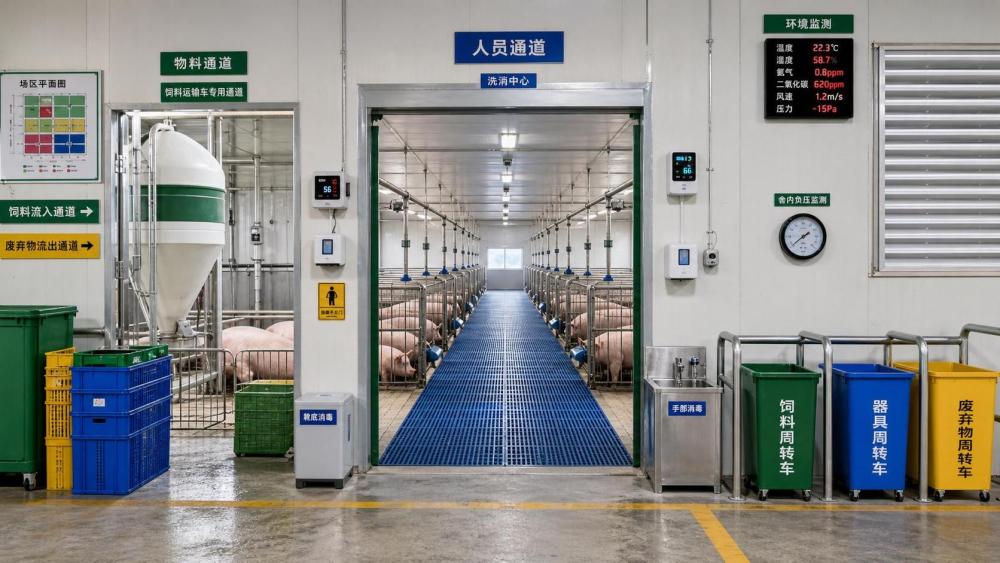
Repeat outbreaks rarely happen because a farm has no rules at all.
More often, livestock biosecurity disease prevention fails because routines look complete on paper, yet break during daily movement, cleaning, ventilation, and staff handoff.
That gap matters across poultry, swine, dairy, and mixed operations.
A visitor log may be filled out correctly.
Meanwhile, shared tools, poorly separated traffic lanes, or missed barn pressure checks reopen infection routes within hours.
In practical terms, livestock biosecurity disease prevention is an operating system, not a checklist.
It depends on equipment reliability, animal flow, washdown quality, building design, and response speed when something looks wrong.
This is also why the topic fits a broader agricultural intelligence view.
Animal health protection is linked with ventilation control, automation, sensor use, irrigation hygiene nearby, feed logistics, and site-level compliance decisions.
A weak point in one system can quietly undermine another.
Which hidden gaps cause repeat outbreaks most often?
The most expensive failures are usually small, repeated, and tolerated for too long.
They do not always look dramatic during audits.
They show up as “normal shortcuts” that weaken livestock biosecurity disease prevention day after day.
- Dirty-to-clean traffic crosses at loading docks, service corridors, or mortality removal points.
- Disinfection is performed, but contact time is too short to be effective.
- Boot changes happen at entry, yet gloves, tablets, and handheld tools move between zones.
- Ventilation settings protect temperature, but ignore pressure balance and airborne pathogen control.
- Water lines, feed bins, and delivery interfaces are cleaned inconsistently.
- Downtime between groups is scheduled, but not verified by environmental testing.
In many operations, the building envelope also deserves more attention.
Damaged seals, uncontrolled inlets, poor drainage, and standing moisture make livestock biosecurity disease prevention harder, even with trained teams.
Climate control is especially important in enclosed poultry and swine systems.
Negative-pressure ventilation, cooling pads, and barn automation can support disease control.
Still, if sensors drift or maintenance slips, the same systems can spread risk instead of containing it.
A quick way to spot a weak biosecurity chain
One useful test is to map every movement touching animals, air, water, feed, and waste.
If any step depends on memory instead of control, that step deserves review.
How do you tell whether the problem is training, design, or equipment?
This is where many reviews become too general.
Saying “staff need better discipline” may sound reasonable, but it often hides a design flaw.
A good livestock biosecurity disease prevention review separates behavior failures from system failures.
If staff skip a step because the wash station is badly placed, the process is poorly engineered.
If alarms occur but no one trusts the sensor, maintenance and calibration are the issue.
If protocols vary by shift, supervision and training consistency need attention.
More mature operations usually review three layers together:
- Human layer: route discipline, PPE changes, cleaning sequence, response timing.
- Facility layer: zoning, drainage, washable surfaces, service access, dead-end airflow.
- Technology layer: ventilation controls, door alarms, pressure sensors, access tracking, automated dosing.
AMI often frames farm performance through connected systems rather than isolated devices.
That approach is useful here.
Livestock biosecurity disease prevention improves faster when climate control, automation, sanitation workflow, and compliance records are reviewed as one chain.
What should be checked first after a repeat outbreak?
The first response should not start with rewriting the whole policy.
Start with where the barrier failed in practice.
That gives livestock biosecurity disease prevention a measurable reset instead of a symbolic one.
A focused review usually includes the following:
- Trace recent animal, people, vehicle, feed, and service movement across zones.
- Confirm actual disinfectant concentration and real contact time.
- Review barn pressure, temperature, humidity, and alarm logs for silent deviations.
- Inspect downtime evidence, not just the planned production calendar.
- Check whether mortality handling and waste routes crossed clean areas.
- Test whether tools, hoses, crates, and loading interfaces stayed within zone rules.
In actual operations, this review works best within 24 to 72 hours.
Memories are clearer, data logs are easier to reconstruct, and equipment conditions have not yet been reset.
If disease pressure is linked to airflow or moisture, delayed review can miss the real cause.
Are records enough, or do you need proof from the field?
Records are necessary, but they are not enough on their own.
Livestock biosecurity disease prevention should be supported by visible proof.
That can include door event logs, sensor trends, ATP checks, surface swabs, camera reviews, and route observations during normal work.
When paperwork and field reality disagree, field reality wins every time.
Can automation and climate systems reduce outbreak risk, or do they add complexity?
They can do both.
Well-managed systems strengthen livestock biosecurity disease prevention by reducing manual inconsistency.
Poorly managed systems create a false sense of control.
Automated ventilation can stabilize pressure and reduce stress.
Access systems can improve zoning discipline.
Sensor-based water and climate monitoring can identify conditions that favor pathogen survival.
Still, every automated control needs maintenance logic behind it.
A drifting humidity sensor, blocked inlet, or failed curtain actuator can quietly reshape disease exposure.
The better question is not whether automation is useful.
It is whether the site can verify performance, respond to alarms, and maintain calibration discipline.
This is where agricultural intelligence platforms add value.
They help compare ventilation strategies, livestock automation options, and biosecurity system features in the context of animal health, labor pressure, and compliance exposure.
What does a stronger livestock biosecurity disease prevention plan look like in practice?
A stronger plan is usually simpler to execute and harder to bypass.
It defines clean and dirty routes clearly.
It links sanitation steps to verification.
It assigns responsibility by shift, not just by department.
And it treats environmental control as part of livestock biosecurity disease prevention, not a separate engineering topic.
A practical improvement path often includes:
- Redraw movement maps for people, animals, vehicles, tools, feed, and waste.
- Set pass-fail checks for cleaning, drying, and disinfection stages.
- Tie ventilation and pressure targets to routine verification, not seasonal adjustment only.
- Separate critical tools physically, not just by written instruction.
- Review supplier and service-entry controls with the same rigor as internal controls.
- Use trend data to spot repeated weak points before clinical signs return.
The main lesson is straightforward.
Livestock biosecurity disease prevention works when barriers are visible, measurable, and maintained under real operating pressure.
If outbreaks keep returning, the next step is to audit the process flow, verify equipment performance, and challenge any routine that depends on assumption rather than evidence.
That kind of review usually delivers more value than adding another rule to an already overloaded manual.
Related News
- 00
0000-00
How to Evaluate an Agricultural Modernization Supplier for a Farm Automation Project - 00
0000-00
How to Size Negative-Pressure Air Inlet Systems for Uniform Poultry House Ventilation - 00
0000-00
How Low-Temperature Grain Dryers Protect Seed Viability and Reduce Cracking - 00
0000-00
How to Evaluate a Tractor Automation Supplier for Retrofit Compatibility and Support - 00
0000-00
What Maintenance Costs Should Be Budgeted for High-Horsepower Tractors?